
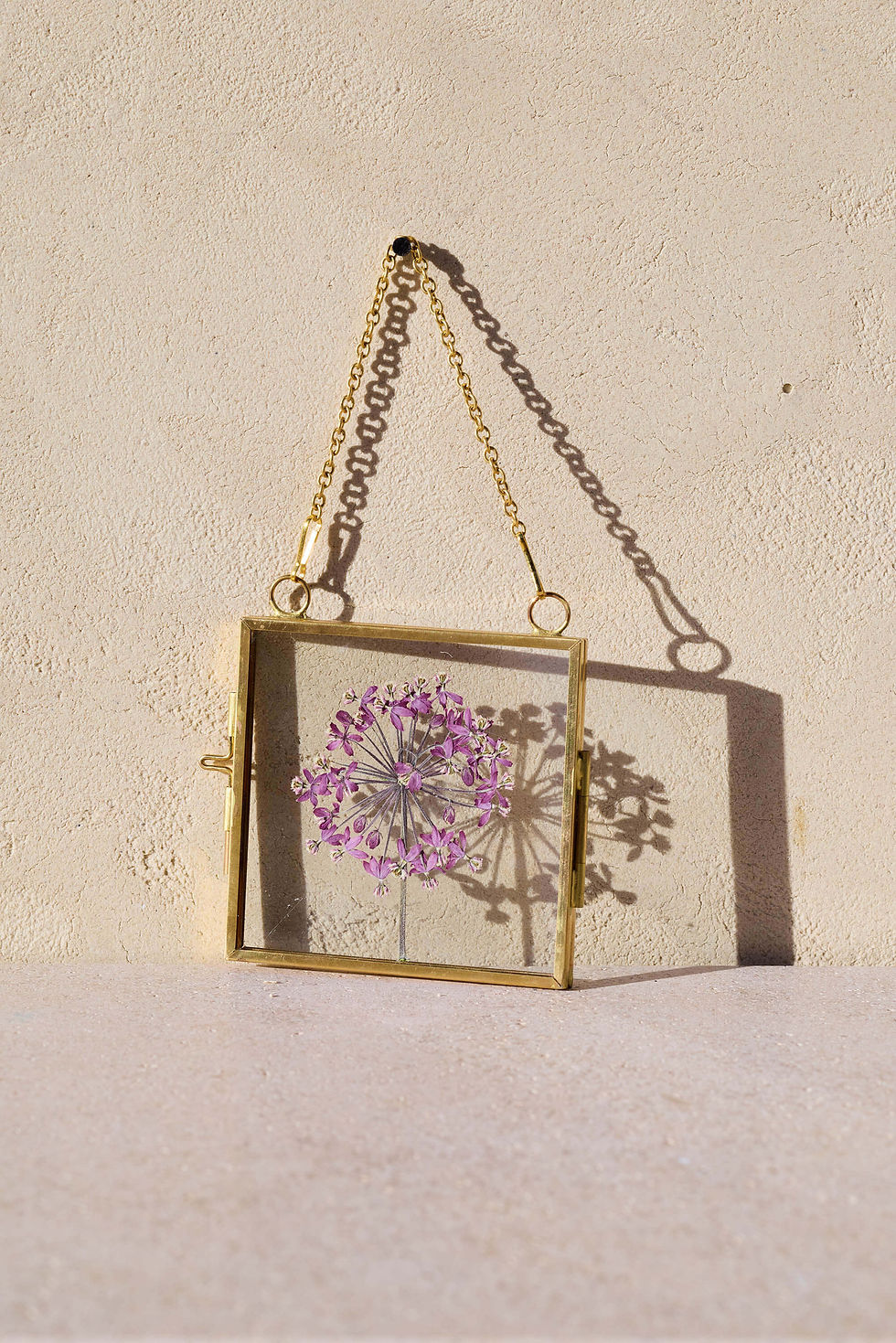


Flower Pressing: Between History and Art
Updated: Apr 5
One of the central questions I am asked by those who encounter me and my work is: how are flowers actually dried? Is it pressing flowers in a book, like in the old days? Drying them in the microwave? Hanging them to dry? And how do the flowers manage to keep their color? To answer these questions, I return to my own search for the primary origins of the craft of flower pressing.
The craft of flower preservation possesses a rich historical background, cultural evolution, and a vast, fascinating body of knowledge that exists at the intersection of history, science, botanical research, and artistic expression.
Alongside my own creative work, I sought the origins of this unique technique. The childhood memory familiar to many—of drying flowers between the pages of books—is actually based on a traditional technique that I use today: drying flowers using a mechanical press. This press is constructed of wooden boards containing blotting paper, and it is tightened using screws or tension straps.
My journey to find the origins of this technique began by chance, during one of the protest evenings in Jerusalem in late February 2025. There, I met Ari Cohen, a man dear to my heart and an architect for whom I once worked. When Ari heard about my involvement in the field of flower pressing over the last three years, he recommended that I visit the National Library and search for the "Dried Flower Albums."
This was the beginning of a quest in which I discovered true treasures among the bookshelves of the Rare Collections rooms at the library. I was introduced to magnificent collections that have been preserved in an extraordinary manner—dried flower albums that became a veritable industry in 19th-century Jerusalem.
Upon a cushion placed on a table in the Rare Collections room, album after album—which I had reserved prior to my arrival—was presented to me. They were all bound in decorated olive wood covers, and inside, the preserved treasures were revealed.
Between the pages of the albums appeared lithographs of holy sites in Israel, photographs taken at various locations (which serve as further evidence of the development of photography during that period), and colorful landscape illustrations. Between them, beneath delicate parchment paper, lay the dried flowers. The flowers were arranged in beautiful compositions with colors that had been miraculously preserved.
These albums became souvenirs for pilgrims and visitors to the Holy Land and were also sold overseas. The flowers in the albums were ostensibly attributed to the places where they were picked, though today it is known that most were gathered from the Jerusalem area, and some were even cultivated flowers grown in private gardens.


From the albums at the National Library
One of the most spectacular compositions that caught my eye was the work of women who lived in the American Colony in the Old City. On the page, there was also a reference to the scientific botanical names of the flowers—a practice that was not common in most albums.
While searching for the source of this craft, I discovered the wonderful book The Dried Flower Albums of Jerusalem by Ami Zehavi. In his book, Ami gathered stories and information he researched regarding these albums—research he conducted for over 12 years.


Albums of the American Colony
I contacted Ami and asked to meet him. I discovered an enthusiastic collector, rich in knowledge, who had also built a private collection that I was privileged to see up close.
Alongside the rare albums he showed me, I received detailed explanations about the souvenir industry that developed. I heard about the impoverished residents of Jerusalem at the time and how gathering flowers served as a source of livelihood. He told me about the men and women who would go out to the wadis surrounding the Old City, gather seasonal flowers, and bring them to plant-drying workshops. I heard from him about publishers, about women from the American Colonies who wrote descriptions in their books of the workers engaged in flower gathering, and about how the drying technique was executed. He spoke of the atmosphere in those days among the people working and picking in the fields, the sale of the souvenir albums in shops on Jaffa Street in Jerusalem, and the marketing development that targeted both devout Christians and Jews in the Diaspora. I could have listened to the wellspring of knowledge flowing from him for hours.
The information Zehavi presents in his book transforms the "flower albums" from a "tourist item" into a historical document. This journey between the albums in the library and Zehavi’s collection emphasized how much a dried flower is more than the technique itself. It is a testament to longing, to human creativity, and to our ability to preserve fleeting beauty within an eternal frame of materials. Encountering these albums is like encountering love letters from the past, written in the handwriting of both nature and man.
Thousands of such albums were published; some are kept in the National Library, and others are in the private hands of enthusiastic collectors. I managed to acquire a few small albums like these at an auction.
An album from the private collection of the Zehavi family. / The albums I purchased
On the Intersection Between Science and Art
Another concept I was exposed to during my search comes from the botanical-scientific world: the term Herbarium. This is a systematic collection of dried and preserved plants for research, education, and scientific documentation.
One of the most fascinating places—one I found difficult to leave from the moment I entered—is the National Herbarium at the Hebrew University at Givat Ram, Jerusalem. The Herbarium holds magnificent scientific collections of plants dating back to 1920, used for unique botanical research and documentation. Over 700,000 sheets of plants from the Land of Israel and its surroundings are curated there. Each plant in the collection is accompanied by information about the person who collected it, the date and location of collection, and further details about the environment.
At the Herbarium, I was welcomed by Eyal Ben-Hur, the Herbarium manager, who explained the entire process: from receiving the dried plants to placing them in a special cooling facility at -40°C for two weeks (to prevent insects) and then the sorting and cataloging process. The library also holds collections of mosses and seeds, and an entire world of books with stunning botanical illustrations.
The way the sheets are cataloged served as an inspiration for me. It has been integrated into a similar technique in my own work; I catalog the flowers I collect, recording where they were gathered and at what time of year. This method of labeling alongside the artwork provides a "preservation seal" and instills a sense of appreciation for every single flower I choose to collect and create with.

After visiting the Herbarium in Jerusalem, I was curious to find the source of the first herbaria. I discovered that the first mentions came from Italy in the mid-16th century, in the cities of Pisa and Padua. Luca Ghini was the leading botanist, considered the father of the modern herbarium, who turned the drying of plants into a systematic scientific method. He developed the format of documentation sheets that are still recognized today.
Alongside herbaria dedicated to research, private herbaria emerged that were characterized as artistic endeavors. An example of this is the work of the American poet Emily Dickinson (1830–1886), who at the age of 14 created a herbarium containing specimens of about 400 dried plants, all scientifically identified. This document is considered an important botanical-cultural record, and it is archived at the Harvard University Library.
From the Harvard University website
In the 17th and 18th centuries, an art form called Oshibana developed in Japan. Unlike in Europe, the use of dried flowers in Japan was less scientific and more seasonal-aesthetic in nature, through a desire for seasonal preservation.
An Additional Technique: Cyanotype
Another documentary method for preserving plants developed in 19th-century London by Anna Atkins, a British botanist and photographer. She is considered a pioneer of the sun-print/cyanotype method and was the first woman to publish a book illustrated with photographs. This method of sun-printing with plants allows them to be documented with extreme accuracy—almost like an X-ray—while connecting this unique technology to an artistic language.
This technique intrigued me, and after experimenting with it, I created several works that incorporate dried flowers using this method on fabric and paper. The beauty of this method is that it highlights the delicacy and elegance of the flowers through light and the transparency revealed by the print.
My works on fabric using the Cyanotype technique
On the Intersection Between Flowers, Creation and Thought
As part of my creative process, I dedicate time to drawing inspiration from visiting exhibitions and reading professional literature (I have dedicated a separate blog chapter to book recommendations).
In August 2025, an exhibition titled "Yesh Prahim" (There are Flowers) was launched at the National Library in Jerusalem. The exhibition gives expression to plants and flowers within the context of the Israeli landscape and nature, and their presence in Israeli culture and space. It reveals items from the dried albums held in the library, botanical illustrators' books, poems, and texts that show their historical and Zionist context, through to their connection today, including themes of mourning and commemoration.
Through the items on display, the exhibition showed how botanical research in the Land of Israel was not merely a scientific branch, but a means of shaping a new Hebrew culture and strengthening the bond with the land. Alongside plant guides and magnificent illustrations that spread botanical knowledge, intellectuals, artists, poets, and writers joined in, connecting the observation of nature and flowers as a means of artistic expression and an educational tool.
I will conclude this blog chapter with a quote by the Japanese essayist Shirasu Masako, which I encountered at an exhibition titled My Life in Flowers by artist Mirit Weinstock at the Eretz Israel Museum (MuzA) in February 2025:
"A natural flower is beautiful, but when touched by a human hand, it becomes a thought."